
Dates: Thursday, 5th Februray, 2026 – Sunday, 8th February, 2026
Address: Booth F05, NSIC Grounds, Okhla, New Delhi
Artists: Abhishek Dodiya, Deepanjali Shekhar, Parul Sharma, Rajat Kumar, Ram Dongre, Rinku Choudhary, Santanu Dey, Satyanarayana Gavara, and Sunil Yadav
RESIDUE: THE RAW ARCHIVE
We are the archivists of the overlooked. This presentation is built from the dust of Delhi’s streets, the rust of Gujarat’s shipyards, and the sweat of Andhra’s harvest. Here, the ‘Residue’ is not what is left over—it is the evidence of what remains unbroken. From the vibrational geometry of a silent sound wave to the divinity found in the act of labour, our artists invite you to witness the raw, honest pulse of our time.
Residue is not what is left behind.
It is what refuses to disappear.
The city enters the body long before it enters the drawing. (Parul)
Structures fail first at their edges. (Abhishek)
What is erased does not disappear; it changes form. (Ram)
Every line we draw leaves something outside. (Santanu)
ABHISHEK DODIYA
Abhishek works with metal as if it were skin—bent, welded, scarred, and reassembled. Trained as a welder, he learns from the resistance of material itself, allowing structures to appear fragile rather than fixed. His surfaces hold the pressure of storms, labour, and overbuilt cities.
PARUL SHARMA
Parul’s practice emerges from walking and observing the city. Using brick dust, graphite, and naturally settled particulate matter, she allows urban space to physically imprint itself onto her work. Her drawings and surfaces question how access, restriction, and atmosphere shape lived experience.
SANTANU DEY
Santanu works with materials drawn from the urban environment—e-waste, soil, brick, steel, charcoal, and industrial debris. His practice reflects on overconsumption, shrinking natural spaces, and the psychological landscapes produced by these conditions. Through reduction and restraint, his surfaces hold a quiet sense of anxiety and loss.
RAJAT KUMAR
Rajat paints from observation and emotion rather than with an aim to narrate. In this series he paints spaces after people have left them. Using rollers and scrapers, he follows mood rather than image, allowing rooms and objects to carry emotional weight. Absence becomes an active presence in his work.
His work lingers in the quiet aftermath of lived moments.
RAM DONGRE
Ram’s practice is built through layering, erasure, and repetition. Drawing from mural traditions, miniature painting, and vernacular imagery, his surfaces resemble time-worn walls. Labour, memory, and spirituality emerge through what is scraped away.
DEEPANJALI SHEKHAR
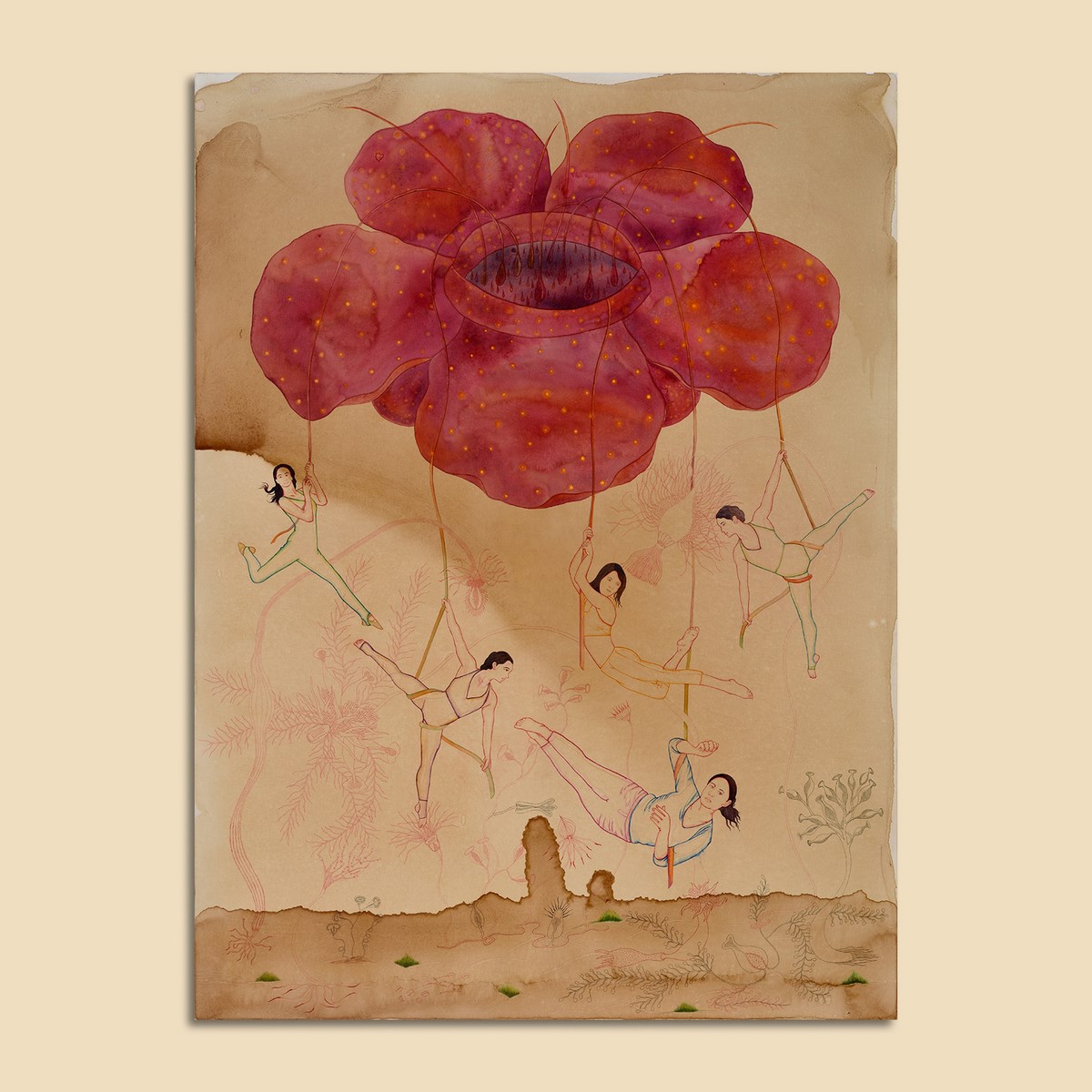
Deepanjali draws from the body, memory, and the natural world. Botanical forms, architecture, and figures fold into one another on tea- and coffee-toned surfaces. Each work carries traces of places lived, left, and absorbed.
RINKU CHOUDHARY
Rinku’s paintings unfold from the rhythm of everyday life. Layered compositions allow gestures, routines, and thoughts to overlap without hierarchy. Her practice finds balance and harmony within movement and repetition.
SUNIL YADAV
Sunil translates geometry, rhythm, and vibration into visual form. Influenced by sound waves and resonance, his imagery reveals unseen structures that shape space and perception. Silence becomes a site of order rather than absence.
DEBAJIT
Debajit’s practice grows from travel, longing, and questions of identity. Moving across landscapes—real and imagined—his paintings dissolve borders and fixed locations. Moments appear briefly, held in paint, then allowed to drift.