
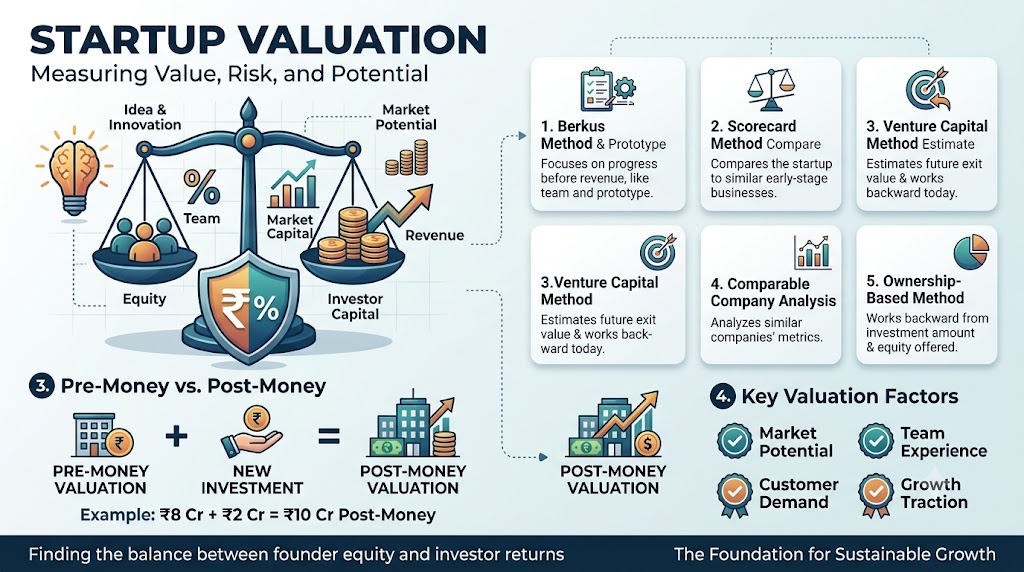
Startup Valuation is an important consideration for entrepreneurs seeking funding to turn innovative ideas into sustainable businesses. It determines the estimated worth of a startup and helps founders and investors negotiate how much capital will be invested in exchange for an ownership stake. For early-stage companies that may not yet have consistent revenue or a proven business model, Startup Valuation depends on several factors, including market potential, product development, the founding team’s experience, customer demand and future growth prospects.
Unlike established businesses, startups often have limited financial records to demonstrate their performance. Investors must therefore assess both the company’s current position and its ability to create value in the years ahead. A well-supported valuation can help founders raise capital on reasonable terms, plan expansion and build investor confidence.
Why Startup Valuation Matters to Entrepreneurs and Investors
Startup Valuation influences how much equity founders surrender when raising funds. If a business receives a lower valuation, its founders may need to give away a larger ownership stake to secure the same investment. A higher valuation can help preserve ownership, but it must be supported by credible growth expectations.
Investors, meanwhile, evaluate whether the startup can generate sustainable revenue, attract customers and compete effectively in its market. They also consider business risks, future funding requirements and the possibility that projected returns may not materialise.
Finding a reasonable valuation is therefore essential for both parties. It establishes a basis for negotiations and helps align expectations around the company’s future development.
Five Key Startup Valuation Methods Investors Use
There is no single formula for determining the value of every startup. Investors use different Startup Valuation methods depending on the company’s stage, industry, financial information and fundraising objectives.
1. Berkus Method: Assessing Potential Before Revenue
The Berkus Method is often used to assess startups at the idea or early product-development stage, when reliable revenue forecasts may not be available. It evaluates factors such as the business concept, product prototype, management team, strategic relationships and progress towards commercialisation.
A startup with a tested product, an experienced team and early customer interest may be considered less risky than a business that has only an initial idea.
For example, an agricultural technology startup developing an affordable irrigation solution may strengthen its valuation case by demonstrating that farmers have tested the product and experienced practical benefits.
The method provides a structured way to assess progress, although the value assigned to each factor depends on the market and the assumptions used.
2. Scorecard Method: Comparing Similar Startups
The Scorecard Method compares a startup with the typical pre-money valuations of similar early-stage businesses. Investors adjust the benchmark according to factors such as team experience, market size, product differentiation, competition and sales opportunities.
A company with a capable founding team and a clearly defined customer base may receive a more favourable assessment than a similar business with limited market validation.
This method is most useful when reliable information about comparable startups and funding rounds is available. Differences in geography, industry and business maturity must also be considered.
3. Venture Capital Method: Estimating Future Returns
The Venture Capital Method estimates a startup’s potential future value and works backwards to determine an appropriate investment valuation today.
For example, if an investor expects a startup to reach a future exit value of ₹100 crore and seeks a fivefold return, an investment of ₹20 crore would theoretically need to grow to that amount, before considering dilution, additional funding and other investment terms.
This approach helps investors assess whether the potential returns justify the risks of backing an early-stage company. However, the outcome depends on realistic assumptions about revenue growth, competition, market demand and the timing of an eventual exit.
4. Comparable Company Analysis: Understanding Market Benchmarks
Comparable company analysis examines the valuations, funding rounds, acquisitions and relevant financial multiples of similar businesses.
Investors consider factors such as revenue, growth rates, profitability, customer retention and business models. A software company with recurring revenue, for instance, may be assessed differently from a startup that is still testing whether customers are willing to pay for its product.
These comparisons provide useful benchmarks, but the valuation of another company cannot automatically be applied to a different startup.
5. Ownership-Based Method: Calculating the Investment Stake
In some funding negotiations, founders and investors work backwards from the amount of capital required and the ownership percentage being offered.
Suppose a startup raises ₹2 crore in exchange for a 20% stake. Its implied post-money valuation would be ₹10 crore, while its pre-money valuation would be ₹8 crore.
This approach makes it easier for entrepreneurs to understand the ownership implications of fundraising and compare different investment offers.
Pre-Money vs Post-Money Valuation: What Is the Difference?
Pre-money and post-money valuation are two essential concepts in Startup Valuation.
Pre-money valuation is the agreed value of a company immediately before a new investment.
Post-money valuation is the company’s implied value immediately after the investment is added.
The calculation is:
Post-money valuation = Pre-money valuation + New investment
For example, a startup with an ₹8 crore pre-money valuation that raises ₹2 crore would have a post-money valuation of ₹10 crore.
Understanding these figures helps founders calculate potential equity dilution and evaluate the financial implications of a funding round. Actual ownership outcomes may also depend on existing shareholdings, convertible securities and the terms of the investment agreement.
How Founders Can Improve Their Startup Valuation
A strong valuation case requires evidence that the business can move from an idea to a commercially viable operation. Founders should prepare realistic financial projections, explain their revenue model and demonstrate how the proposed investment will support measurable business milestones.
Evidence of customer demand, repeat purchases, successful pilot projects, distribution partnerships and revenue growth can strengthen investor confidence. Entrepreneurs should also understand their operating costs, cash requirements and plans for future fundraising.
For startups serving India’s retail, manufacturing, agriculture or technology sectors, demonstrating a clear customer problem and a practical solution can be particularly important. Investors want to understand not only how large the opportunity is, but also how the company plans to capture it.
Founders should avoid focusing exclusively on securing the highest possible valuation. An inflated figure can create pressure to deliver unrealistic growth and may complicate subsequent funding rounds if business performance falls short of expectations.
Startup Valuation as a Foundation for Sustainable Growth
Startup Valuation combines financial analysis, market research and judgement about future business potential. While different methods may produce different estimates, the objective remains the same: to arrive at a reasonable value that reflects the startup’s current progress and future opportunities.
For entrepreneurs, understanding Startup Valuation can lead to more confident fundraising decisions, better ownership planning and stronger investor relationships. For investors, it provides a framework for weighing risk against potential returns.
Ultimately, a successful funding decision depends on more than the valuation figure. A viable business model, a capable team, genuine customer demand and disciplined financial management are what help turn investment into long-term business growth.