
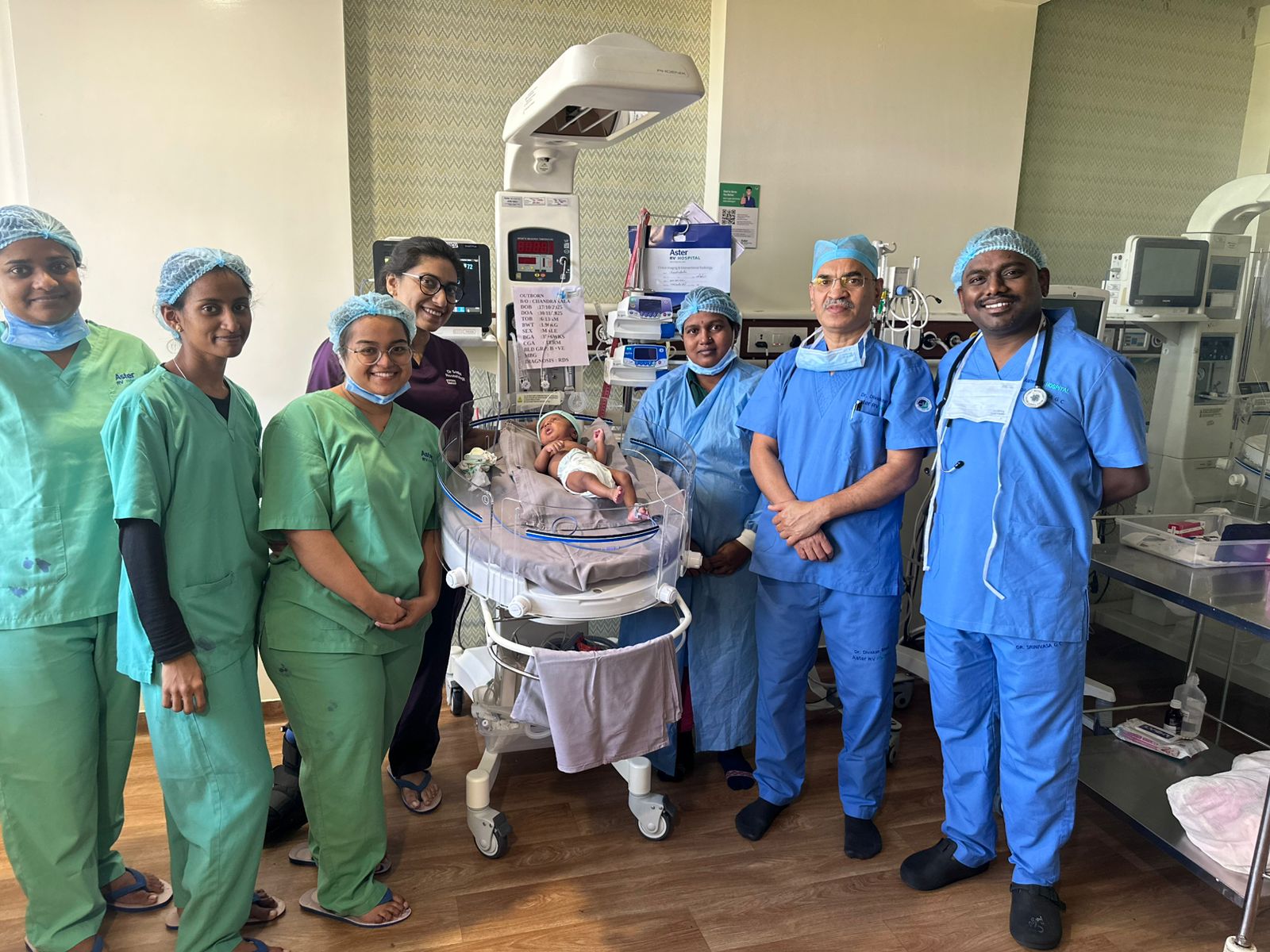
Bengaluru, Jan 19: Aster RV Hospital, Bengaluru, has successfully treated a 1-month-6-day-old baby boy suffering from severe breathing distress, feeding difficulty, and repeated cardiac arrests—symptoms caused by a congenital heart defect known as Double Aortic Arch. Occurring in only about 1 in 10,000 infants, the anomaly forms a vascular ring that tightly compresses both the trachea and esophagus, making early diagnosis and timely surgery critical for survival.
The baby, from Gulbarga, had been struggling with breathing and feeding issues since birth. After initial visits to other facilities, the child was referred to Aster RV Hospital in a critical condition. By the time the infant reached the emergency department, he had already suffered one to two episodes of cardiac arrest and required ventilator support.
Dr Kalale Nikhil Nagaraj, Consultant – Paediatrics & Neonatology at Aster RV Hospital, Bangalore, played a crucial role in the baby’s stabilisation and intensive neonatal care, closely monitoring respiratory status, coordinating ventilator support, and optimising the infant’s condition before and after surgery.
Initial evaluation with an echocardiogram at Aster RV revealed a small hole in the heart, commonly seen in many infants, but also raised suspicion of a more serious underlying issue.
Dr Bharath AP, Consultant – Pediatric cardiologist at Aster RV Hospital, Bangalore, identified features suggesting signs of an extremely rare anomaly known as Double Aortic Arch, a congenital vascular ring seen in only 1 in 10,000 babies. The baby’s airway and food pipe were tightly encircled by an abnormal blood vessel loop.
Dr Divakar Bhat, Lead Consultant – CTVS Surgery, Aster RV Hospital, Bangalore, said,
“In my 25 years of practice, this is the first time I have encountered such a case. The double aortic arch was encircling both the trachea and the esophagus, causing the child’s worsening breathing and feeding difficulties. The baby’s airway and food pipe were under extreme compression. Without surgery, survival would have been impossible. The moment we divided the vascular ring, the obstruction was relieved, and the child’s recovery was immediate and remarkable.”
Given that the condition cannot be treated medically and requires surgical correction, the cardiac team proceeded with urgent open-chest surgery. Despite financial challenges faced by the baby’s parents, the hospital management extended support through medical assistance schemes to ensure timely intervention.
Following the surgical release of the vascular ring, the baby’s condition improved rapidly. He was successfully taken off the ventilator the next day, began feeding normally, and maintained stable breathing without oxygen support.
Dr Bharath AP added,
“Early identification is key in such rare congenital anomalies. This case demonstrates how multidisciplinary expertise, from diagnosis to critical care to surgery, can truly change outcomes. The baby is now thriving, and we expect him to lead a completely normal life.”
Within 2–3 days of the procedure, the baby was fit for discharge, with follow-up appointments scheduled for stitch removal and routine monitoring. The successful outcome stands as a testament to the hospital’s advanced pediatric cardiac capabilities, rapid decision-making, and compassionate patient-support systems.
Aster RV Hospital is preparing CT aortogram images, intraoperative photographs, and post-recovery visuals for media reference.