KYOTO, Japan (August 12, 2026) — The Imperial Hotel, Kyoto has announced a significant preservation milestone for the Yasaka Kaikan, the historic 1936 building that forms the heart of the recently opened luxury hotel in Kyoto’s Gion district. Following review by Japan’s Council for Cultural Affairs, the structure’s status as a Registered Tangible Cultural Property has been retained under the new designation “Former Yasaka Kaikan,” recognizing the extensive efforts undertaken to preserve the landmark while giving it new life as part of the hotel.
Opened in March 2026, the Imperial Hotel, Kyoto was created through the careful preservation and adaptive reuse of portions of the Yasaka Kaikan, a beloved local landmark that had faced increasing challenges due to age, deterioration, and seismic concerns. Rather than pursuing demolition, Imperial Hotel elected to preserve key architectural elements of the historic structure, integrating them into the hotel’s design while safeguarding the building’s legacy for future generations.
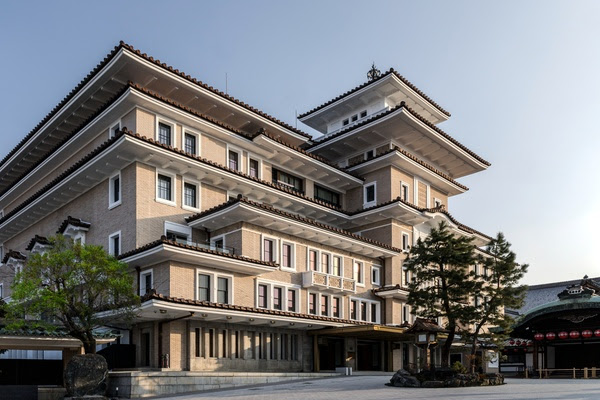
“From the beginning, our goal was to honor the architectural and cultural significance of the Yasaka Kaikan while ensuring its relevance for generations to come,” said Reiko Sakata, General Manager of the Imperial Hotel, Kyoto. “The continuation of its cultural property registration recognizes not only the building’s history, but also the importance of preserving meaningful places through thoughtful restoration and reuse.”
Among the most significant achievements of the project was the preservation of the building’s iconic southwestern façade, long recognized as a defining feature of Kyoto’s historic streetscape. Original exterior tiles and terra-cotta ornamentation were carefully conserved and reinstalled, while portions of the original structural framework were retained. The building’s distinctive copper roof and decorative metalwork were also reconstructed using traditional techniques.
Particularly notable was the restoration of more than 16,000 original exterior tiles, many of which were removed and reinstalled using ikedori, a traditional Japanese conservation technique that allows historic materials to be salvaged and reused without damage. Additional preservation efforts included the restoration of the building’s decorative terra-cotta reliefs featuring traditional floral motifs, as well as the conservation of historic interior details in the entrance vestibule, including original etched glass detailing dating to the building’s construction.
Completed in 1936, the Yasaka Kaikan was originally built adjacent to the Gion Kobu Kaburenjo and served generations of Kyoto residents as a theater, performance venue, cinema, dance hall, and gathering place. Its architecture blends traditional Japanese design elements with early twentieth-century construction techniques, making it one of Kyoto’s most distinctive cultural landmarks.
Today, the Imperial Hotel, Kyoto carries that legacy forward. The 55-room hotel combines contemporary luxury and time-honored hospitality with architectural preservation, offering guests the opportunity to experience one of Kyoto’s most historic buildings while contributing to its continued stewardship. In April 2025, the hotel joined The Leading Hotels of the World.